
About Ross House

Introduction

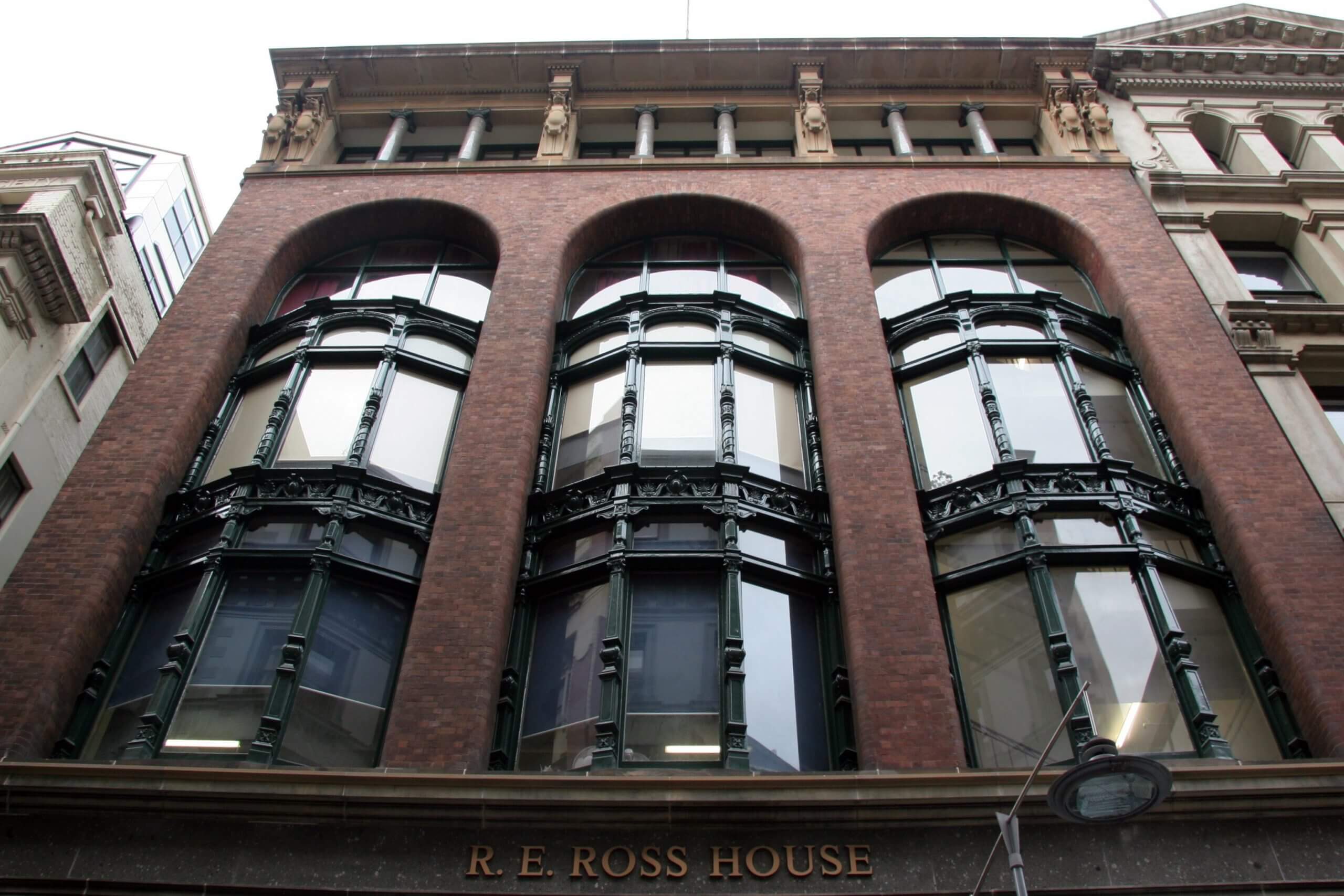
Ross House is a five-storey building centrally located in Melbourne's central business district. Ross House offers resources to a diverse range of self-help and small community and environment groups. Ross House operates as a non-profit and is wholly self-managed by its members, providing a dynamic working model of the community in action.

Ross House has the capacity to house over 60 organisations and offers office space at below market rates. An even larger number of groups use the building's other facilities, such as meeting rooms, mail boxes, photocopiers and fax machines.

By providing a stable environment and cheap resources, Ross House aims to reduce the insecurities and financial pressures that so often hamper the activities of small community organisations.

The Association

Ross House is managed by its members through the The Ross House Association, whose role is to maintain the building, develop the resources available and to encourage the development of the community of tenants within the building.

All tenants are required to be members of the Association and many other users of the building's resources are also members.

All the members of the Ross House Association are small community and self-help groups who are collaborating towards a just and environmentally sustainable society. They wish to achieve social change through advocacy, campaigning, community education and the provision of resources and information.
back to top

History

Finding a place that small community organisations could call home captured the imagination of a diverse range of people, many of whom invested a tremendous amount of energy, time and creativity into the development of the Ross House project.

At a seminar in July 1980, self-help groups highlighted their need for reasonably priced, secure accommodation, combined with access to essential physical resources such as photocopying and typing facilities.

Around the same time, the RE Ross Trust approached the Victorian Council of Social Services for advice on how to allocate an amount of money for a special project. After much discussion, it was agreed to use the funds to purchase a building to resource small community organisations.

In April 1985, ANZ Trustees purchased the historic Royston House from the former State Electricity Commission, renaming it Ross House.

In keeping with the project's goals, a ongoing community consultation process was devised in the drafting of both management structure and reservation plans.

The concerted efforts of a wide range of groups, interacting in different areas of concern across Victoria, has produced an energetic and distinctive community association.
back to top

The Building

When the building now known as Ross House was opened with much pomp and ceremony over 100 years ago, little did the owners know that the original warehouse was destined to become a vibrant and exciting resource centre for community groups.

The grand opening in May 1899 of the Sargood warehouse was a celebration of the groundbreaking features designed to combat the problems of multistorey buildings that were still a new concept 100 years ago.

The main challenge was fire resistant construction, a vital issue, as the original Sargood warehouse was destroyed by fire. The external windows were installed with ‘drenches' (which are still there!) and the building fitted with automatic sprinklers that are still in use today, although the heads have been replaced.

Three separate events were held to mark the opening of the building:

  • the main event was a demonstration of the sprinkler system – a dramatic touch to the celebrations
  • a ‘smoke concert' was held in the Melbourne Town Hall for all the construction crew and catering included refreshments, cigars and tobacco
  • customers and commercial travellers attended an opening where the warehouse had been stocked with samples of the firm' goods

Frederick Thomas Sargood was a leading figure in Melbourne as a merchant and politician until his death in 1902. The best known monument to his success is his house, Ripponlea, in Elsternwick. Ross House is the remaining section of the original Sargood warehouse built in Flinders Street in 1879.

In its time, the building represented the success of the Sargoods' commercial empire. It was built at a time when a warehouse was not simply a place to store goods, but reflected its owner's status as surely as office buildings do today. The building itself is an excellent example of American Romanesque revival architecture in Australia.

In 1929, the building was purchased by the Melbourne Electric Supply Company (the SEC) and was called Royston House. The SEC demolished the Flinders Street section of the building and replaced it with Clements House. Royston House was used for office space and staff recreation facilities.

In 1985, the Victorian Community Foundation bought the building and transformed it into Ross House: a resource centre for community groups. In 1986, the Historic Buildings Council determined that Ross House was of special significance to the State of Victoria, and it was included on the Council's register.

In 1994, the building was included on the register of the National Trust of Australia (Victoria).

Acknowledgment to Jack Gilding ‘History and Background to the building at 247 – 251 Flinders Lane'.
back to top

Hayden Raysmith Address 2 November 2007

Prof Raysmith has had a distinguished career in the public, community and philanthropic sectors. He was the founding chair of Melbourne Community Foundation, the Executive Director of the Victorian Council of Social Service (VCOSS), chair of the Advisory Board of the Institute for Social Research at Swinburne University and held the positions of Director of Youth Affairs and Director of Public Health in the Victorian Government. He currently chairs the Abbotsford Convent Foundation, which is developing an arts, cultural and educational precinct on the Yarra, near the Collingwood Children’s Farm.

Professor Raysmith has been a key member of an international university/government collaborative project that is developing measures of progress across five domains: economic, social, environmental, cultural and governance.

As founding chair of the Melbourne Community Foundation Professor Raysmith has also been at the cutting edge of triple bottom line reporting and corporate social responsibility. He is currently a member of the Expert Community Advisory Committee established by Insurance Australia Group (IAG).

Hayden was Executive Director of VCOSS at the time when the idea of a resource building arose in 1981; International Year of Disabled People. In 1983 he visited the only other similar buildings; Meringhoff in Berlin and Poland St (owned by the Rowntree Trust) in London. He was instrumental in engineering funding for Ross House and spent 16 years negotiating its development and gradual move to self management. He was the bridge between the self help and advocacy groups and the Ross Trust, other funders, government and ANZ Trustees (who own the building). He has been a friend, supporter and mentor for Ross House since 1981 and continues that support behind the scenes to this day.

Hayden congratulated Eva Meredith and Patricia Lauria on providing strong leadership to the Association.

When the concept of Ross House was originally mooted a 3 year business plan was drawn up but this turned into a 16 year plan. This shouldn’t deter people to take an initial step (in regard to ownership). The dream was that somehow people who work in the community and try to change public policy need a foothold in our democracy, our city. Ross House is a symbolic representation of people working together. It is a part of society and people working with others, and this has not changed since it was established.

Often people think that the individual contributions they make are not important; however Ross House would not be here today if so many individuals did not make contributions. Over the last 20 years many people have contributed their ideas and support even when it is not recognised.

The building itself has a fine history and this has been beautifully reflected in the annual report. The Wurundjeri were the original custodians of the land. The building was initially the Sargood Butler warehouse. It burnt down and was then re-built. It was taken over by the SEC and then purchased by the Victorian Community Fund and held in trust by the ANZ Trustees. At first only the first floor was occupied by self-help groups. The struggle took a decade for the whole building to be self-managed. This culminated in the signing of a lease by the Brotherhood of St. Laurence in 1996.

In the next decade we need to keep the dream alive and remember the vision. We must respect the work of people who have done this great work and keep this going. The sense of ownership needs to be rock solid and we need to keep alive the self-management model. Members need to always see the Committee of Management as an extension of this. We need to widen this sense in keeping the dream alive. This is not just about the people in the building. It provides a voice for other people in the community, especially for people who are struggling as well as those who have made contributions and been involved in the past.

It is about empowerment and strength, not about being victims. It is about rights, justice and strength. The vision needs to be taken to another level to look at how there can be total ownership of the building. Other buildings overseas have folded. The ANZ Trustees should take great pride in what they have given birth to. Our government should feel pride in what we have as the Cain Government did when Ross House was first established. We need to take on the challenge for the future.

back to top